
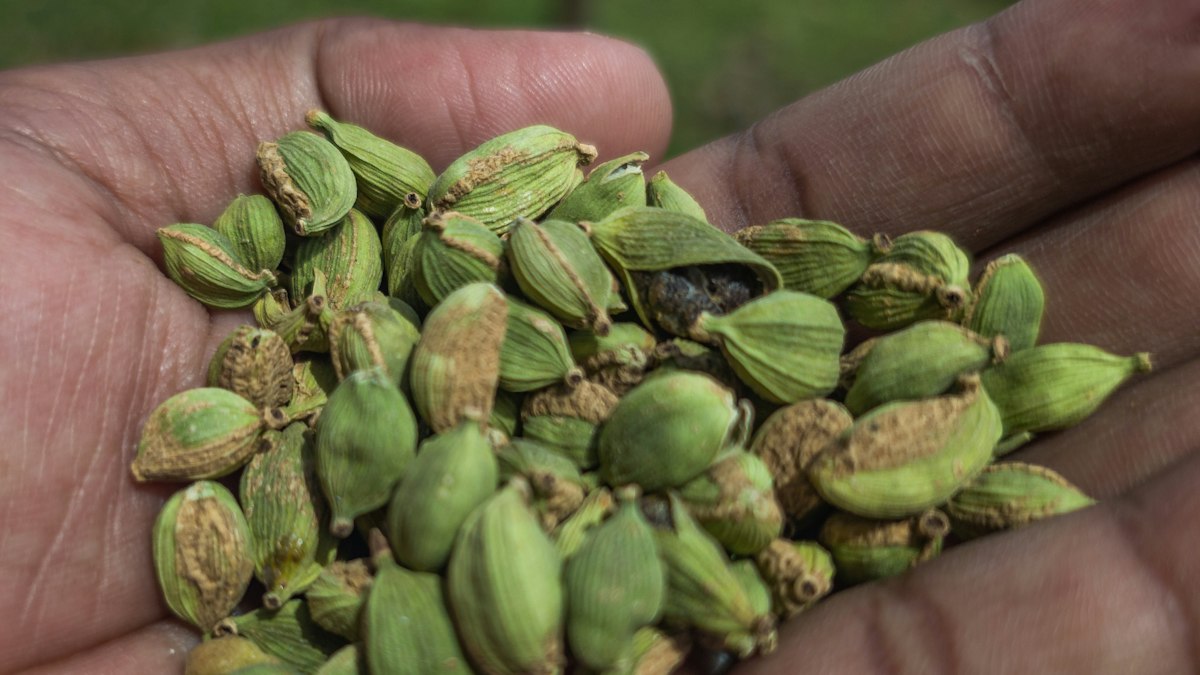
Green cardamom is among the most expensive spices India exports. It is also graded in a way that rewards appearance as much as it rewards flavour, which surprises buyers coming from other commodities.
This page explains what the size grades mean, why colour fades, and how to decide which grade your product actually needs.
Size grades are sieve sizes
Cardamom is graded by passing it over sieves with holes of a fixed diameter. The grade tells you which sieve the capsules were retained on.
The common export grades are 6mm, 7mm, 7.5mm and 8mm bold. A capsule graded 8mm did not pass through an 8mm opening.
Bigger capsules command substantially higher prices. The jump between 7mm and 8mm bold is the steepest in the range, and it can be a large percentage of the price.
Our green cardamom is graded across these standard export sieves.
Bigger does not mean more aromatic
Here is the part that costs buyers money.
Capsule size is driven by growing conditions and by selection. It tells you about the plant and the field.
Aroma is driven by maturity at harvest and by how the capsule was dried. It tells you about timing and processing.
These are different causes. A large capsule that was picked early or dried badly can carry less aroma than a smaller one that was handled well.
So if you are buying cardamom for flavour, size is not the number to buy on.
Colour is about drying, and it fades
The green a buyer pays for is chlorophyll retained through the drying process.
Cardamom is dried in curing chambers. Get the temperature and airflow right and the capsule keeps its green. Dry it too fast or too hot and it yellows.
That much is in the supplier’s control. What follows is not, entirely.
Colour continues to fade after drying. Two things drive it:
- Moisture. Cardamom held above roughly 12 per cent will lose colour noticeably in storage and transit.
- Light. Exposure bleaches the green.
This is why cardamom is packed in moisture barrier cartons rather than in sacks, and why it is a shorter shelf life product than most of the spice catalogue.
A lot that looked excellent at origin can arrive visibly duller if the moisture was marginal or the packing was wrong. Packing and loading matters more for this product than for almost any other.
Three grades of the same thing
It helps to think of cardamom as having three separate quality measures that do not move together.
- Size: the sieve grade. Drives most of the price.
- Colour: green retention. Drives retail appeal.
- Volatile oil: typically 6 to 8 per cent in good Indian material. Drives flavour and extraction value.
Because they are independent, you have to decide which ones you are paying for.
If you are packing for retail
Buy on size and colour. Your customer picks the pack off a shelf and judges it by eye. A bold, bright green capsule sells.
Volatile oil still matters, but it is secondary to appearance in this channel.
If you are a manufacturer or extractor
Buy on volatile oil and accept a smaller capsule.
A beverage company, a confectionery manufacturer or anyone extracting is going to grind or process the capsule. Nobody sees it. Paying an 8mm bold premium for material that will be crushed is spending money on something your customer will never experience.
This one decision often saves more than every other line on the contract combined.
Empty and split capsules
Every lot contains some empty capsules and some split ones. It is unavoidable.
An empty capsule has no seed inside. It weighs almost nothing and contributes nothing. A split capsule has opened, which means the seeds inside have been exposed to air and have lost aroma faster.
The percentage of these belongs on your specification. Two per cent maximum is a common figure for export material.
This is the number that separates a well selected lot from one that merely passed through a sieve. A sieve sorts by size. It does not know whether a capsule is full.
Origin and season
Most Indian cardamom comes from the Idukki district of Kerala, with some from the Nilgiris and parts of Karnataka.
Harvest runs roughly from August to February, with several pickings across the season. Early pickings and late pickings differ in size and colour.
Prices move sharply through the year and between years, because the crop is sensitive to rainfall. Cardamom is one of the more volatile spices in the trade.
If you have a steady annual requirement, it is worth discussing a forward position rather than buying spot four times a year.
Shelf life and storage
Cardamom does not keep as well as whole pepper or coriander. Plan for that.
Practical points:
- Store cool, dark and dry. Heat and light are both enemies.
- Keep it in its barrier packing until you use it.
- Do not buy more than you will use within the stated shelf life, even if the price looks good.
- If you must hold stock, hold whole capsules rather than ground cardamom. Ground loses aroma very quickly.
What belongs on a cardamom specification
- Sieve size grade: 6mm, 7mm, 7.5mm or 8mm bold.
- Colour: the green grade, described or matched to an approved sample.
- Volatile oil, as a minimum percentage.
- Moisture: 12 per cent maximum, and lower is better.
- Empty and split capsules, as a maximum percentage.
- Foreign matter and stalk.
- Packing: moisture barrier cartons, with the unit weight stated.
- Residue panel against your destination market.
Because appearance is part of what you are buying, an approved physical sample is more useful here than on most commodities. Agree one at the start and keep it sealed. Writing a specification covers how to tie a sample into a contract so it means something.
A note on price
Cardamom prices are high and they move. A quote is usually valid for a short window.
If you are comparing offers, make sure you are comparing the same grade, the same volatile oil and the same empty capsule limit. A cheaper quote at a lower specification is not cheaper.
The short version
Size grades are sieve sizes and they drive the price. They do not drive the aroma.
Colour is a drying outcome and it fades with moisture and light, so packing matters.
Retail packers should buy on size and colour. Manufacturers and extractors should buy on volatile oil and save the premium. Put the empty and split capsule limit on the contract either way.