
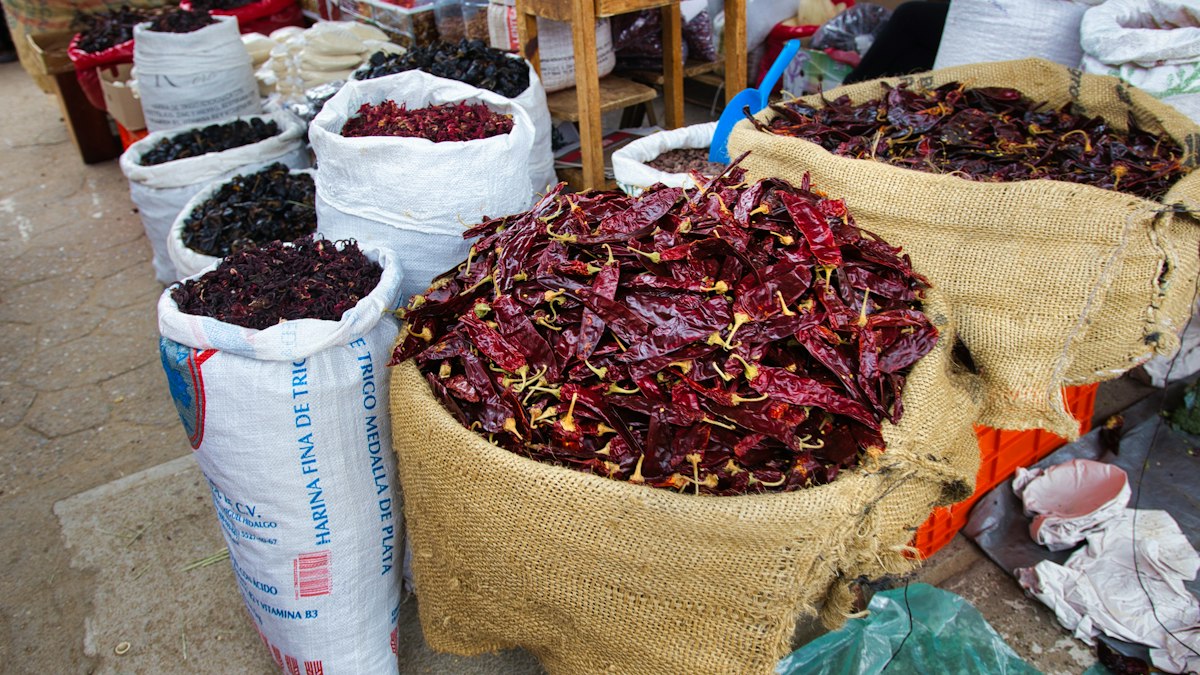
India grows a great many chilli varieties. The export trade turns mostly on two of them: Teja and Byadgi. They are not substitutes for one another, and buying the wrong one is an expensive way to learn the difference.
This page explains what each one is for, why most real formulations use both, and what to put on your contract so the product does not move between shipments.
Two chillies, two different jobs
The simplest way to hold this in your head is that chilli has two values, and they move independently.
Heat is measured in Scoville Heat Units, written SHU. It comes from a compound called capsaicin.
Colour is measured as an ASTA value. It comes from pigments called capsanthin and capsorubin.
A chilli can be high in one and low in the other. Teja and Byadgi sit at opposite corners.
Teja: bought for heat
Teja, also called S17, is grown mainly around Guntur in Andhra Pradesh. Guntur is the largest chilli market in India.
Teja runs roughly 75,000 to 100,000 SHU. That is hot. It is the standard raw material for hot sauce, for pickle manufacture, and for capsaicin extraction.
Its colour value is moderate, usually ASTA 30 to 40. Nobody buys Teja to make a dish look red.
It is supplied with stem or stemless, in cartons or in compressed bales. Stemless costs more, because the stems are removed by hand and the weight you pay for is all usable product.
Our Teja chilli is reported with actual Scoville per lot, not a standing claim.
Byadgi: bought for colour
Byadgi comes from the Byadgi belt of Karnataka. The pod is long, wrinkled and deep red.
Byadgi is low in heat. It usually sits well under 15,000 SHU. Its colour value is high, typically ASTA 60 to 80 or above.
This is the chilli that gives a Kolhapuri or Mangalorean dish its deep red without making it hot. It is also the main Indian source of chilli oleoresin, which is used as a natural colouring in food manufacturing worldwide.
Our Byadgi chilli is graded on ASTA, because that is the number extraction buyers contract on. If you want to understand what that number is and how it is measured, ASTA colour value explained covers the test in plain terms.
Most real formulations use both
Here is the part that changes how you buy.
Because colour and heat are independent, you cannot reliably hit a specific pair of values with a single variety. Teja gives you heat but not enough colour. Byadgi gives you colour but almost no heat.
So the standard answer in food manufacturing is a blend. Byadgi brings the ASTA figure up. Teja brings the Scoville up. The blender adjusts the ratio to hit both targets.
This is not a compromise. It is how a repeatable product is made. Our grinding and blending service exists for exactly this.
The practical consequence for you is about how you write the order.
A buyer who specifies “chilli powder, ASTA 80, 40,000 SHU” is describing a blend. They will get a repeatable product, shipment after shipment.
A buyer who specifies a single variety and then complains that the heat moved between shipments is asking a crop to be more consistent than crops are.
Heat moves with the season
Pungency changes more than most buyers expect. Rainfall and temperature while the pods are ripening both affect it. A dry, hot season usually produces hotter chilli.
The size of the swing is real. A sauce recipe balanced against last year’s crop will often need adjusting against this year’s.
There is a straightforward way to manage this. Ask your supplier to report the actual Scoville value for each lot shipped, not a standing range. Then you can adjust the recipe before production starts, rather than discovering the difference in a finished batch.
A supplier who cannot tell you the pungency of the specific lot they are shipping is not testing it.
Which one do you need?
Work backwards from the product.
- Hot sauce, chilli paste, pickle: Teja led, because heat is the point. Add Byadgi if the colour is too dull.
- Natural colouring, oleoresin extraction, paprika style powder: Byadgi, contracted on ASTA.
- Curry powder, snack seasoning, ready meal base: almost always a blend, contracted on both numbers.
- Retail chilli powder: depends on your market. South Indian and Sri Lankan buyers usually want more heat. European retail usually wants more colour and less burn.
- Whole dried chilli for retail packs: appearance matters most, so pod length, colour and the percentage of broken pods all go on the specification.
What else belongs on a chilli contract
Beyond variety, colour and heat, four more lines prevent most problems.
Moisture. Usually 10 to 12 per cent maximum. Above that, mould risk rises sharply during a sea voyage.
Damaged and broken pods. State a maximum percentage. A lot can meet its colour target and still look poor in a retail jar.
Aflatoxin. This is a mould toxin and it is strictly limited in most import markets. The European Union sets the tightest limits. Test against the destination’s figure, not a general standard.
Stem or stemless, and the packing form. Bales are cheaper to ship. Cartons protect appearance better.
A note on price
Byadgi generally costs more per kilo than Teja. That is not a quality ranking. It reflects lower yields and stronger demand from the colour extraction industry.
If you are buying for heat, paying a Byadgi price is wasted money. If you are buying for colour, saving money on Teja will not give you the red you wanted, and you will end up adding synthetic colour or buying again.
Decide which value your product actually depends on. Then buy that.
The short version
Teja is heat. Byadgi is colour. They are not interchangeable.
Most manufactured products need a fixed pair of values, which means a blend rather than a single variety. Specify the ASTA figure and the Scoville range, ask for both to be reported per lot, and add moisture, damage and aflatoxin limits for your market.
Do that and your chilli stops being a variable in your recipe.
If your formulation needs a specific colour and heat pair rather than a single variety, that is a blend. Our red chilli powder is built to an agreed ASTA and Scoville combination and held to it across seasons.